1/30/22

Trucks That Trouble-shoot Themselves, Get Ready, They're Coming!

In the future, equipment is expected to troubleshoot itself 
without human intervention.

iStock_Bombaert818

Thanks to advances in technology, as well as an increasing emphasis on operations efficiency and wise resource use, the role of equipment fleet managers across all industries has changed quite a bit in recent years.

Expect even more changes in the future, says Jim Schug, a principal and engagement manager for FMI Corporation.

Schug, who is also a certified equipment manager and the program lead for the Certification Institute, cites “adapting to technology, innovation, and the new workforce” as three big changes that have occurred in fleet management over the last few years. All fleet management professionals — no matter their industry or the type of equipment managed — need to prepare themselves for more changes on the horizon, he says.

“All vehicles are adapting across the industry,” says Schug, who participated in a panel discussion at ConExpo-Con/Agg in Las Vegas this March on the future of equipment management.

Jim Schug
“We likely are not far from vehicles that troubleshoot themselves, remote sensors that predict what to repair based on the data they collect, and an overall expectation of zero unplanned downtime.” Jim Schug, principal and engagement manager, FMI Corporation headquartered in Raleigh, N.C. and has offices in Denver, Tampa, Phoenix and Houston. “In the future, trucks will be connected and serve as a tracking center; and they will likely evolve out of needing field repairs and emergency calls.”

Need to adapt to changes
Given this move toward automation and advanced technology, fleet equipment — including service trucks —will become much more sophisticated and provide “near perfect information” on how they operate, he predicts. Therefore, he says, companies will only remain competitive in the future if they can do the following: have the best, most “fit” equipment to perform the job; eliminate equipment downtime; and demonstrate the ability to sustain ongoing operations 24 hours a day, seven days a week. And much of this will rest on the shoulders of fleet management leadership and their ability to adapt to industry changes, Schug argues.

“This future is a big shift from where we are today and puts more pressure on the equipment manager to lead what happens in the field, so the intensity and importance of the role increases,” says Schug, who has a bachelor of science degree in quantitative economics from the U.S. Military Academy at West Point and a master of science in engineering management from the University of Missouri. “If equipment managers are not already sitting at the leadership table today they should be … and I certainly believe they will be in five years.”

Whether playing catch-up or preparing for more changes, fleet managers should take proactive steps to better position themselves (and their companies) for what lies ahead, he says.

“Learn how to collect data and enter it into an efficient system that helps inform when making difficult decisions,” says Schug, who acknowledges many people already use maintenance management systems in their decision-making.

However, he advises fleet managers to think beyond simply collecting and entering data. On that note, he emphasizes how the gathering, harvesting and analyzing of data by fleet managers can help their CEOs make good decisions.

Recognize data’s value
“You need to recognize how valuable that data is to your lifecycle costs and current operations. Equipment data will drive operations in the future,” says Schug, whose company provides management consulting and investment banking services to various industries including construction and engineering.

Given the importance of data in fleet management, Schug says it is critical for fleet managers to “stay engaged” and “plugged-in” when it comes to industry associations and vendors. By doing so, fleet managers can keep abreast of new technologies, products and/or practices, all of which can benefit their overall fleet management efforts.

“You do not want your firm to fall behind the innovation curve. At the same time, we are seeing strategy evolve from a ‘gut feel’ to a more data-driven approach,” Schug says.

According to Schug, though, a data-driven strategy in fleet management is more of a “shared understanding” developed and refined through the experiences of employees serving customers in the field.

“CEOs seldom innovate effectively,” Schug says. “The field and front-line management is the source of all great innovations; and they will be what leads our industry forward. Great firms recognize this and harness it in the development and execution of their strategy.”

Mark Yontz is a freelance writer from Urbandale, Iowa.

Source: http://www.servicetruckmagazine.com/get-ready-for-future-trucks-that-trouble-shoot-themselves/


1/28/22

Configurable Daytime Running Lamps | Ford How-To | Ford


Configure your vehicle’s available daytime running lamps with these quick, easy instructions. Learn more about being a Ford owner here: https://ford.to/3AgEkWP

1/26/22

Another Load of Premier Aluminum Bodies are Shipped!


Premier Truck Center, being a manufacturer of truck bodies for installation in our own shop also furnishes bodies to other distributors nationwide.

These aluminum bodies are destined for a northern state for distributor installations. The load includes eight 12 ft drop-side flatbeds and two chipper bodies. The drop-sides were packaged within the two chipper bodies.

Premier Truck Center is the manufacturer of the standard and custom Premier flatbed bodies in steel and aluminum construction.  

Learn more about the Premier product lines at our website https://premiertruckbodies.com/truck-bodies/ and while there take a look at all the products and services we provide!

1/24/22

Partskeeper Organizer by Ranger Design


Ranger Design launched a revamped version of one of our most popular product lines: the Partskeeper cases and cabinets! These products are perfect for storing and organizing small parts and tools that tradesmen may need to take with them onto the job.

Partskeeper Parts Organizer Carry Case, 62-U5079Our updated Partskeeper cases are rugged and durable and have been put through rigorous strength tests to ensure that we provide our customer only with the highest quality. They now come in a clear hard plastic cover with snaps along the sides that allow them to be stacked on top of one another for easier transportation. We’ve also maximized the design of the case’s storage space by 11% to carry extra tools and hardware onsite.

The Partskeeper cabinets have been updated to our newly branded black end panels, to allow for more rigidity and overall resilience. They come in 4 different sizes, ranging from a single case carrier, all the way up to an 8-case cabinet for those tradesmen with a wider variety of tools.

1/22/22

DH-LM Cantilever lifts - Operation and safety video


                       Dhollandia Operation and safety video for the DH-LM Cantilever lifts 

1/21/22

Tommy Gate Tuckunder Series: TKL


The TKL models feature a single-cylinder, power-down, highly efficient design, and accommodates bed heights from 33 to 47 inches. Lightweight and durable, the TKL combines sleek modern engineering and 2500lbs. of lifting capacity and has applications to fit all major flatbed, stake and van bodies. Visit www.tommygate.com/TKL for more information.

1/20/22

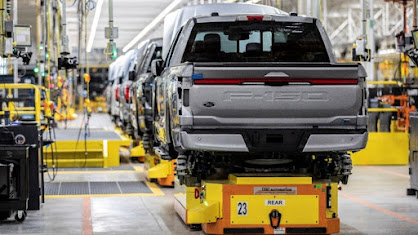
Ford Planning To Nearly Double All-Electric F-150 Lightning Production


  • Ford is planning to nearly double production capacity of the all-electric F-150 Lightning™ pickup to 150,000 vehicles per year at the Rouge Electric Vehicle Center in Dearborn, Michigan, to meet soaring customer demand
  • F-150 Lightning moves to the final phase of pre-production as pickups roll off the line for real-world durability and thousands of miles of testing ahead of customer deliveries this spring
  • The first wave of reservation holders for F-150 Lightning will start converting their reservations to orders; additional reservation holders will be invited in phases to place their order over the next few months. For those who don’t receive invites for the 2022 model year, there will be an opportunity to order for future model years.

With unprecedented demand for the Mustang Mach-E, Ford earlier announced it will increase production starting this year and expects to reach 200,000-plus units per year by 2023; within 24 months, Ford will have the global capacity to produce 600,000 battery electric vehicles annually

Ford Motor Company is planning to nearly double production of the F-150 Lightning™ pickup at the Rouge Electric Vehicle Center in Dearborn to 150,000 trucks per year to meet high demand for the first all-electric version of America’s best-selling vehicle, the F-Series. And beginning Thursday, the first group of reservation holders will be invited to place their orders for the F-150 Lightning.

“With nearly 200,000 reservations, our teams are working hard and creatively to break production constraints to get more F-150 Lightning trucks into the hands of our customers,” said Kumar Galhotra, president of The Americas & International Markets Group, Ford Motor Company. “The reality is clear: People are ready for an all-electric F-150 and Ford is pulling out all the stops to scale our operations and increase production capacity.”

Due to unprecedented customer interest, Ford is implementing a wave-by-wave reservation process, with reservation holders being asked to watch for an invitation via email from Ford or to log into their Ford.com account over the next few months. Those who don’t receive invitations to convert for the 2022 model year will have an opportunity to order a future model year vehicle in due course.

Flexibility is key to Ford’s production system and the way teams are now working to deliver the company’s future lineup of electric vehicles. To deliver this latest increase, a small task force of employees from manufacturing, purchasing, strategy, product development and capacity planning are finding ways to quickly adapt and expand production of the groundbreaking pickup. Ford is working with key suppliers – as well as with its own manufacturing facilities Rawsonville Components Plant and Van Dyke Electric Powertrain Center – to find ways to increase capacity of electric vehicle parts, including battery cells, battery trays and electric drive systems.

“The pride and quality UAW members are putting into building the iconic Ford F-150 Lightning is evident in the high pre-production demand for the new F-150 Lightning truck,” said Chuck Browning, UAW vice president. “UAW members are leading the way in doubling the amount of vehicles Ford is producing for this game-changing model of our legendary union-built vehicle.”

This week marks the final pre-build phase before accelerating into mass production of F-150 Lightning trucks for retail customers and F-150 Lightning Pro for commercial customers. These production-level trucks will be used for testing in real-world customer conditions, collectively accumulating 1 million miles.  

The Lightning is drawing interest from customers of competitor brands at a record rate in North America, with more than 75% of reservation holders new to the Ford brand. Production of the 2022 F-150 Lightning pickup will begin this spring at a starting MSRP of $39,9741 before potential federal tax incentives2.  

Ford is committed to leading the electric vehicle revolution, investing more than $30 billion in electric vehicles through 2025. Over the next two years, Ford aims to emerge as the clear No. 2 electric vehicle maker in North America and then challenge the No. 1 spot as huge investments in battery and electric vehicle manufacturing come onstream. Within 24 months, Ford will have the global capacity to produce 600,000 battery electric vehicles annually.

In addition to scaling Lightning production, Ford recently announced the tripling of production for the Mustang Mach-E and expects to reach 200,000-plus units per year by 2023. Ford’s all-electric van, the 2022 E-Transit, goes on sale early this year.

Ford is building the largest, most advanced, most efficient auto production facility in its 118-year history in Tennessee, where it will assemble next-generation F-Series electric pickups. Together with SK Innovation, Ford is also building three new BlueOval SK battery plants – one in Tennessee and two in Kentucky – to produce advanced lithium-ion batteries to power next-generation Ford and Lincoln vehicles.

This $11.4 billion investment will create nearly 11,000 new jobs at BlueOval City and BlueOvalSK Battery Park in Tennessee and Kentucky and build on Ford’s position as America’s leading employer of hourly autoworkers.

To learn more about the all-electric 2022 Ford F-150 Lightning truck, click here.

# # #

¹MSRP for base vehicle. Excludes destination/delivery fee plus government fees and taxes, any finance charges, any dealer processing charge, any electronic filing charge, and any emission testing charge. Optional equipment not included.


2The federal tax credit is a potential future tax savings. The amount of your tax savings will depend on your individual tax circumstances. Please consult with your own tax or legal professional to determine eligibility, specific amount of incentives or rebates available. The federal tax credit amount may be reduced according to credit phase-out rules. Incentives and additional rebates are not within Ford’s control. This information does not constitute tax or legal advice. For additional information, go to https://www.afdc.energy.gov/laws/409.

About Ford Motor Company

Ford Motor Company (NYSE: F) is a global company based in Dearborn, Michigan, that is committed to helping build a better world, where every person is free to move and pursue their dreams.  The company’s Ford+ plan for growth and value creation combines existing strengths, new capabilities and always-on relationships with customers to enrich experiences for and deepen the loyalty of those customers.  Ford designs, manufactures, markets and services a full line of connected, increasingly electrified passenger and commercial vehicles:  Ford trucks, utility vehicles, vans and cars, and Lincoln luxury vehicles.  The company is pursuing leadership positions in electrification, connected vehicle services and mobility solutions, including self-driving technology, and provides financial services through Ford Motor Credit Company.  Ford employs about 184,000 people worldwide.  More information about the company, its products and Ford Motor Credit Company is available at corporate.ford.com.